
Mill Creek East Previous Resident Eras
No single roll names every person tied to a Mill Creek East home. Ownership records are strongest for owners, while directories and census schedules add household members and renters. Start with the era that matches the question, then confirm the same address or legal description in a second source. The strongest sequence moves from the current parcel to recorded deeds, then into print collections and older government schedules.
| Source | Years Covered | Keeper | Evidence Found |
|---|---|---|---|
| Recorded documents | Most records from July 1976 forward online; earlier deeds on microfilm | Snohomish County Auditor | Grantors, grantees, dates, parcels, and legal descriptions |
| County city directories | Runs from 1882 through 2005, with many gaps | Washington State Library | Named residents, addresses, work, spouses, and later phone listings |
| Federal census | Schedules through 1950 open in 2026 | National Archives and genealogy collections | Household members, relationships, ages, birthplaces, and work |
| Sanborn maps | Everett volumes for 1914 and 1955; other county-town microfilm | Everett Public Library | Building footprints, uses, lots, and former street context |
| Permits | Current and historical reach varies by jurisdiction | City of Mill Creek or county PDS | Work dates, project type, applicant, and owner clues when public |
For a recent sale, the assessor and deed index are the fastest pair. For a mid-century household, begin with a county directory and then locate the matching census district. When the street did not yet exist, rely on the parcel's legal description, subdivision, nearby road, and former community label. Those details survive name and boundary changes better than a postal address.
Anchor Mill Creek East Past Residents
The Snohomish County Property Summary Search accepts a parcel number or a street address, with optional city, state, and ZIP fields. A wildcard can help when the street text differs. The returned account can show the owner, taxpayer mailing address, situs address, parcel number, legal description, sales history, and a link to more account detail. Situs means the physical property address. A tax mailing address may belong to an owner who lives elsewhere.
Record the first ten digits of the parcel number, the full legal description, and any subdivision or lot-and-block terms. A parcel is the county's mapped unit of land. One street address can involve more than one parcel, and a condominium or shared tract can create extra accounts. Those facts matter before tracing previous residents because the wrong parcel creates a convincing but false ownership chain.
Note: A deed proves a recorded interest in land, while a tax mailing address does not prove that the named person occupied the house.
Mill Creek East Previous Resident Deeds
The Auditor's recorded-document search covers most documents recorded since July 1976. A free account has been required since March 2, 2026. Searches can use a name, document type, recording number, recording date, parcel ID, book and page, or legal-description category. Name searches use last name and first name, while parcel searches use the first ten digits. These controls make the index useful even when an older instrument omits the modern street address.
Earlier work shifts to microfilm at the county Customer Service Center. Recording staff also accept requests by phone, mail, email, and in person. The recorded document copy request form is the mail route when the exact item is known. A search result is an index entry; the recorded image or a certified copy is the stronger source.
The online cutoff reflects digitization, not the beginning of ownership. Mill Creek East developed rapidly after the rural era, so a parcel can cross the cutoff while the modern house or street name does not.
Read Mill Creek East Previous Residents
The county's search page shows the categories used to find land records. Open the Snohomish County recorded-document search before reviewing the captured interface below.
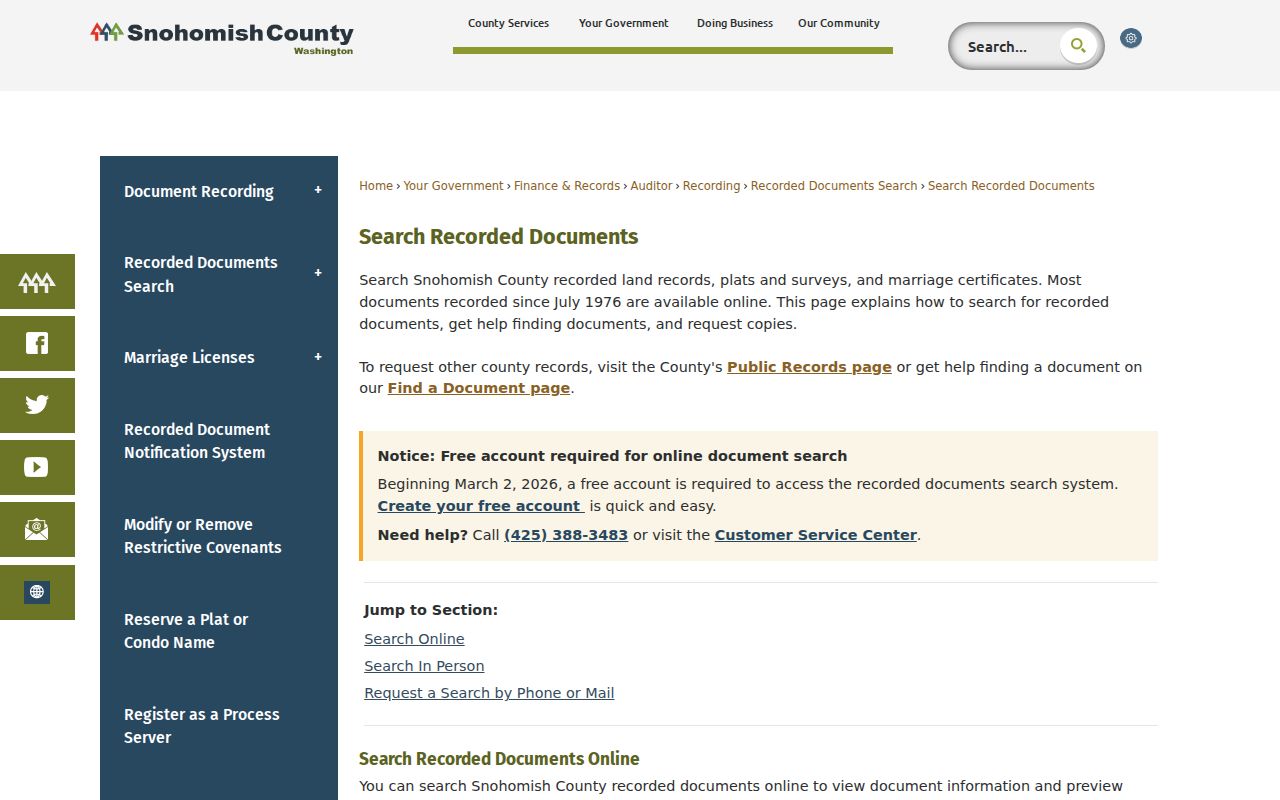
The screen is the bridge between a present parcel and each prior named party. Copy the recording number and legal description before moving backward, since names alone can match unrelated people.
Trace Mill Creek East Past Residents
A chain of title is the sequence of recorded transfers for one parcel. Begin with today's account, not a remembered surname. The current owner's acquisition deed names the seller. That seller was often the buyer on an earlier deed, which allows the same land to be followed back one transfer at a time.
- Search the current street address in the assessor roll. Save the parcel number and legal description.
- Find the current owner's purchase deed in the Auditor index. Match the parcel, subdivision, and recording date.
- Take the seller, or grantor, and search that person as an earlier buyer, or grantee.
- Repeat the match while logging each recording number, date, party, and legal description.
- At the July 1976 boundary, ask Recording staff for the microfilm or book-and-page route.
- Grantor and grantee
- The grantor gives or sells an interest; the grantee receives it.
- Chain of title
- The linked sequence of recorded transfers for the same land.
- Legal description
- The land description in a deed, often based on a plat, lot, block, or survey rather than a mailing address.
- Criss-cross directory
- A directory arranged by street and house number so an address can lead to an occupant.
Older Mill Creek East Resident Labels
Mill Creek incorporated in 1983 after the surrounding landscape had long been recorded as rural Snohomish County. Historical records may use Everett, Bothell, Martha Lake, Silver Lake, Alderwood Manor, a rural route, or a subdivision name. By 2008, the incorporated city had expanded through 17 annexations. The Mill Creek East census-designated place is still not the same legal area as the city.
This geography changes the search. A house now carrying a Mill Creek mailing label may have county permits rather than city permits. A directory may shelve the household under a nearby town. Use SCOPI to capture the parcel, lot, and neighboring roads, then search each former label. The city's local history account documents the shift from farms and a planned golf-course community to the incorporated place.
Date Mill Creek East Resident Changes
Permits help date construction, additions, decks, demolitions, and conversions. For an address within the incorporated city, use the Mill Creek permit counter and OpenGov route. County addresses go through PDS online records or a specific county public-records request. Record the permit number, work type, issue date, applicant, and owner fields when public. A contractor's name shows a project role, not occupancy.
Maps fill a different gap. The Everett Public Library's Northwest History Room Sanborn collection lists Everett volumes from 1914 and 1955 plus microfilm for other Snohomish County towns. Exact Mill Creek sheets were not confirmed. The historical map below comes from that official collection page.
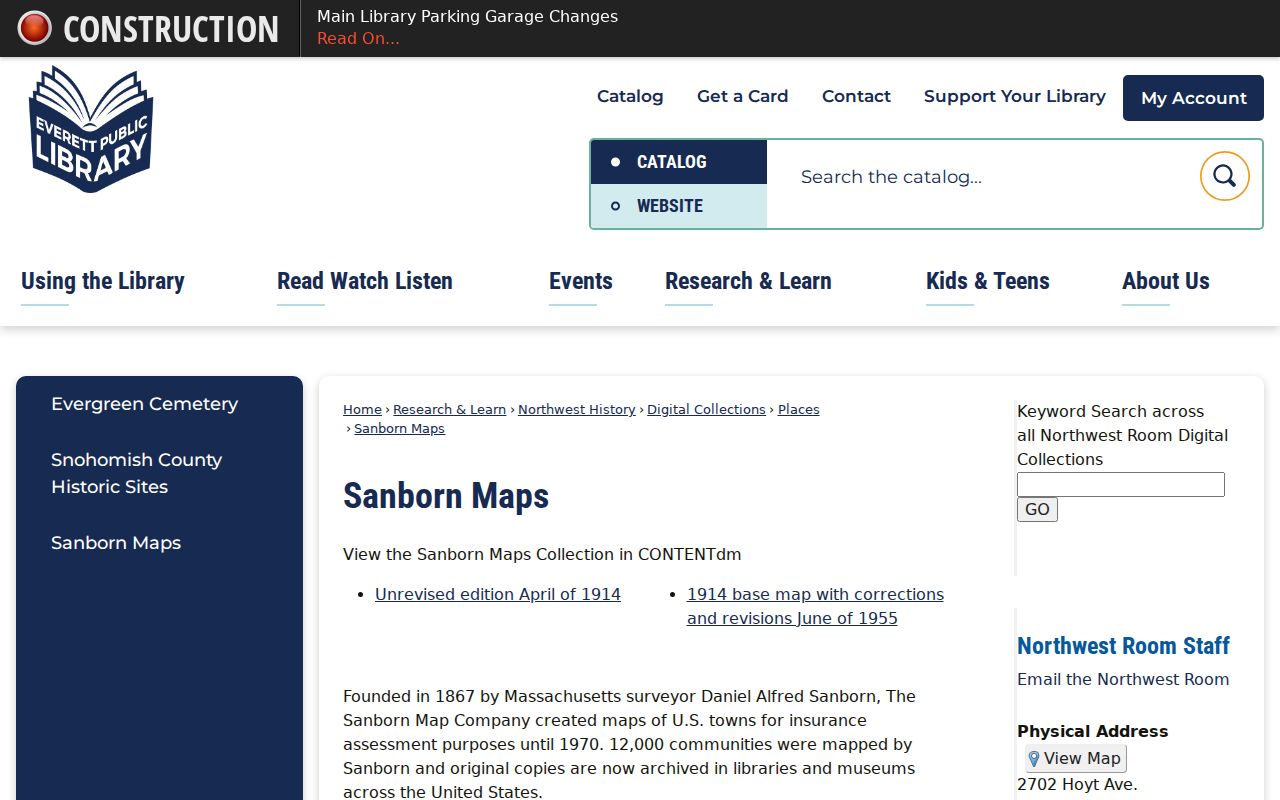
A map can show a building footprint, lot, use, or old street context, but it cannot name every past resident. Pair it with a directory or census entry.
Smokehouse Creek Name Clue
Place names can break an otherwise sound search. Washington granted permission in 2001 to rename Smokehouse Creek as Mill Creek. A newspaper, map, or legal description using Smokehouse Creek may still point to the same modern area. Search both names and compare the parcel or plat before rejecting a result.
The name change is a local reminder that address history follows land, not just current labels. The same caution applies to rural routes and nearby community names. No complete local street-renumbering table was found, so dates and numbers should come from the deed, plat, map, or permit rather than guesswork.
Confirm Mill Creek East Households
Owners are only part of the story. County city directories can name renters, spouses, occupations, employers, and later telephone numbers. The Washington State Library lists Snohomish County runs for 1882 to 1887, 1901 to 1920, 1922 to 1923, 1925 to 1933, 1935, 1937, 1952 to 1982, 1984, 1992 to 1998, and 2000 to 2005. The full shelf and its access limits are described in the Mill Creek East city directories.
Use a short repeatable flow: directory year → address and household → nearest open census year → matching names and neighbors → next directory year. Federal schedules through 1950 are open under the 72-year rule. An enumeration district is the small area assigned to a census taker; maps and surrounding households help when street indexing is weak.
An obituary may name relatives and a later home. A Snohomish Superior Court probate file can identify heirs or a personal representative, while a later deed shows what happened to the property. Funeral-home pages and newspaper archives are leads, not final proof. Confirm the death event through the lawful state or county vital-record route and match the probate case to the same person.
Lawful use. Research previous residents for house history, family history, estate work, or personal curiosity. Never use an address trail to stalk, harass, or harm a living person.