
Mill Creek East Directory Holdings
The best verified year list is the Washington State Library's Snohomish County collection. It is a county run with gaps, not a separate uninterrupted Mill Creek East shelf. Exact publishers and titles must be checked in each catalog or volume because the public coverage page does not identify them consistently. The Polk tradition is associated with Snohomish County directory publishing, but no publisher should be assigned to a given volume without reading its title page.
| Collection | Years | Where Held | Access |
|---|---|---|---|
| Snohomish County city directories | 1882–87; 1901–20; 1922–23; 1925–33; 1935; 1937 | Washington State Library | Catalog help and limited Thursday appointments |
| Later county directories | 1952–82; 1984; 1992–98; 2000–05 | Washington State Library | Limited access after the 2025 public closure |
| Everett and county local history | Exact directory runs not verified | Everett Public Library Northwest History Room | Reference help and local-history access |
| County archives and museum material | Collection dependent | Snohomish County Historical Society | Contact the research desk |
| Census schedules | Through 1950 under the 72-year rule | National Archives, Census, FamilySearch | Online and catalog access varies |
Missing years are real gaps in the listed holdings. A gap does not prove no volume was published, and a listed county year does not guarantee a page for the future Mill Creek East area. Ask staff to search title, county, nearby place, and rural-route terms before ruling out a collection.
Why Mill Creek East Goes Missing
Snohomish County was organized in 1861, long before the current community name. Mill Creek developed from farms into a planned golf-course community in the 1970s, and the nearby city incorporated in 1983. Early city directories therefore cannot be expected to index today's Census-designated place as “Mill Creek East.”
Search Snohomish County first, then test Everett, Bothell, Martha Lake, Silver Lake, Alderwood Manor, and rural-route labels. A modern street may have been described by a tract, farm name, subdivision, or legal description. The city historical panels help interpret that shift, but county deeds and plats provide the firm land link.
This geography also prevents a common error. Mill Creek East is a Census-designated place, while the City of Mill Creek is incorporated. Their cultural and postal landscape overlaps, yet their legal boundaries and city records do not.
Reach Mill Creek East Directory Shelves
The Washington State Library county-directory page is the authoritative coverage list. The library closed to general public access on July 1, 2025 because of funding loss. It lists limited appointment access on Thursdays from 1 to 4 p.m. Request catalog help before travel and name the exact county, year, place variants, and type of entry sought.
The Everett Public Library Northwest History Room is a second path for Everett and county local history. Ask staff about directories, phone books, maps, newspapers, and microfilm under Mill Creek, Bothell, Martha Lake, Silver Lake, and rural routes. The Snohomish County Historical Society can help identify museum and archive material when no catalog hit appears.
The State Library capture shows the official directory collection entry point and year-run context.
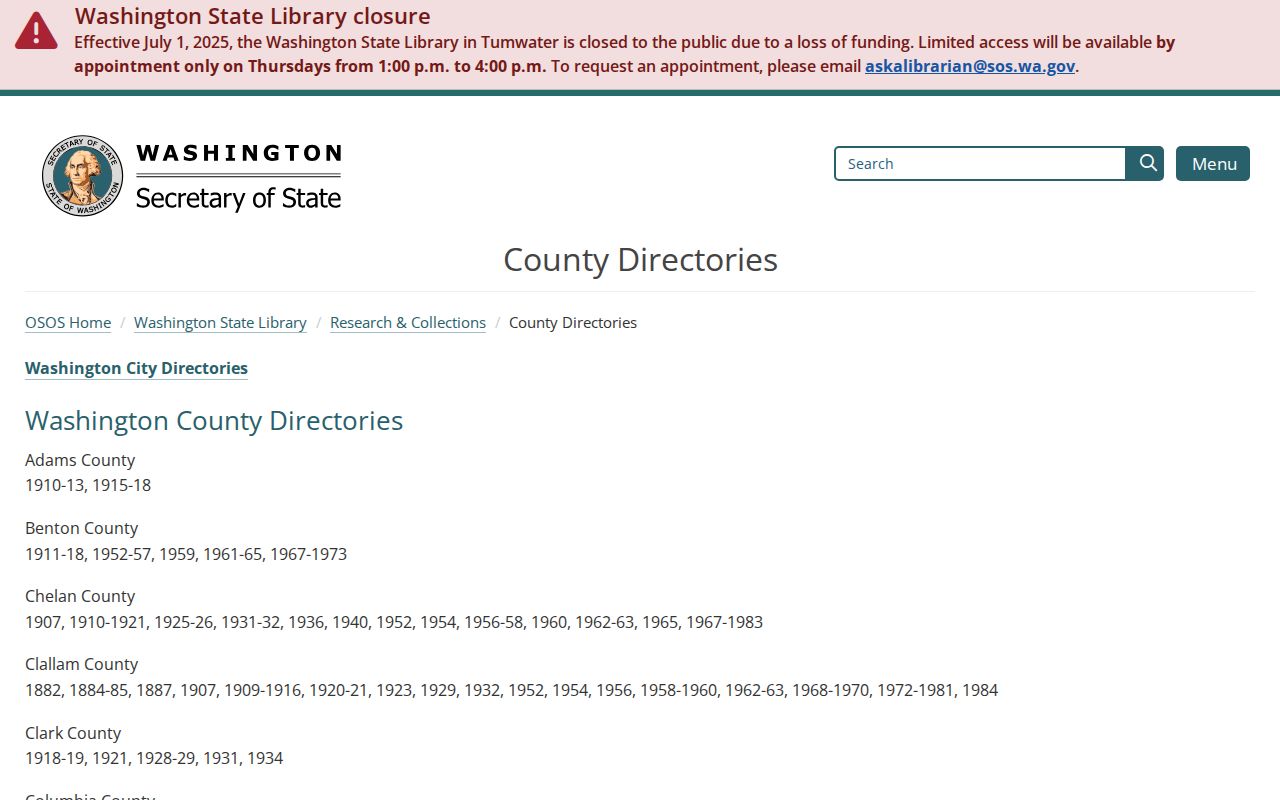
That coverage list should guide a request, but the actual volume and title page remain the evidence for an entry.
Read a Mill Creek East Entry
A city directory line is a dated publication, not a census or deed. It may identify a householder, spouse, work, business, phone, and street address, but conventions differ by publisher and year. Copy the printed line exactly. Initials, misspellings, widow marks, and business-versus-residence labels can all change the next search.
| Name | Surname, given name, initials, and sometimes spouse |
|---|---|
| Work | Occupation, employer, or a business listing |
| Residence | House number, street, and publisher-specific house or boarder mark |
| House status | An owner or renter symbol when that edition defines one |
| Other notation | Telephone, widow, roomer, boarder, or business address |
- Criss-cross directory
- An address-first section arranged by street and house number.
- Householder index
- A name list focused on the person identified with a household.
- Abbreviation key
- The publisher's own code list, often in front matter, which controls how marks must be read.
No public page exposed an actual Snohomish or Mill Creek directory entry during research. Treat the inventory above as a checklist for inspecting a physical or digitized page, not as a transcription from a local volume.
Reverse Mill Creek East Volumes
A later criss-cross section reverses the usual city-directory search. Instead of starting with a surname, look under the street, then move through house numbers. This is useful when the address is known but the householder is not. It can also reveal how the publisher grouped a road before later annexations or postal changes.
Do not assume every volume has this section. Check the table of contents and abbreviation key. A missing house number can mean the address did not exist, the household was omitted, the road used another label, or that edition lacked reverse indexing. Confirm the parcel history before choosing among those possibilities.
Map Mill Creek East Directory Addresses
Sanborn fire-insurance maps can show structures, lots, street names, and businesses around a directory address. Everett Public Library holds Everett paste-over volumes from 1914 and 1955 plus microfilm for Everett and other Snohomish County towns. A Mill Creek-specific sheet was not verified, so check coverage before assuming one exists.
The Library of Congress Sanborn collection offers digitized material, while the Northwest History Room supplies local guidance. A Snohomish-specific caution notes that an 1888 Sanborn is mislabeled for Avenue A. Compare map captions with plats, deeds, and the directory line rather than trusting one label.
The Everett Library capture identifies the local Sanborn access route.
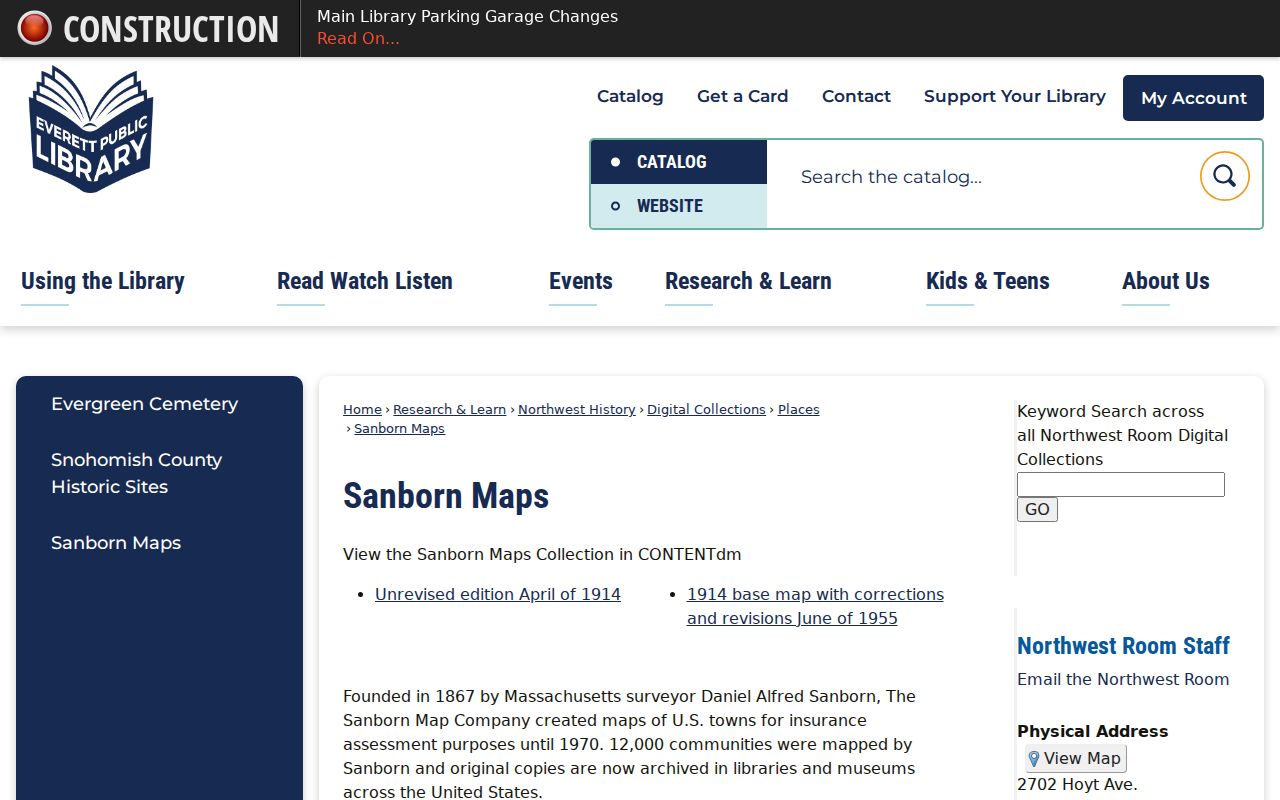
Maps add building context, while the printed volume supplies a dated name-and-address association.
Mill Creek East Directory Timeline
Record dates explain both the depth of the county shelf and the absence of a modern place name in early volumes.
| 1861 | Snohomish County was organized; county records predate Mill Creek identity. |
|---|---|
| 1882–1887 | The earliest State Library directory run listed for Snohomish County. |
| 1970s | The planned golf-course community developed from an older rural landscape. |
| 1983 | Mill Creek incorporated on September 30. |
| 2000–2005 | The latest county-directory run listed by the State Library. |
| 2025 | General State Library public access closed; limited appointments remain listed. |
The incorporation vote included 453 voters, and the historical panels report 324 votes against. The original city covered about 1,160 acres. By 2008, 17 annexations had expanded it to about 2,994 acres. These changes help explain why one household may shift among county, rural, and city labels without moving far.
Trace Mill Creek East Family History
Historical volumes can fill the years between census schedules. Begin with the latest firm name or address, then move one edition at a time. Keep a research log with the edition title, printed year, page, exact address, and every abbreviation. A neat timeline makes a move visible and prevents two people with the same name from being merged.
- Find one firm entry by surname, initials, spouse, or address.
- Search the prior and next available editions, recording each move or gap.
- Use a criss-cross section to test the address when the name disappears.
- Pair the nearest 1900 through 1950 census schedule with the directory year.
- Use newspapers, probate, deeds, church records, or an obituary to resolve the endpoint.
Disappearance alone proves little. The person may have moved, died, changed a surname, used initials, fallen into a missing year, or simply gone unlisted. A census can supply household relationships and birthplace. A deed can show ownership transfer. Probate and obituaries may connect relatives or heirs. Each adds a different kind of proof.
Bridge Mill Creek East Collection Gaps
When no directory entry survives, shift sources instead of forcing a conclusion. Search local newspapers by name, street, subdivision, and former community. Ask the Historical Society about uncataloged local material. Check State Archives for historical vital records after their statutory cutoffs, and search FamilySearch by Snohomish County plus the record type.
Yearbooks, church directories, alumni collections, and public group records can help reconnect people who chose to appear in them. School education records are not a public name-and-address directory. Cemetery and funeral-home references should also be treated as leads until a certificate, obituary, cemetery office, or probate record confirms the facts.
For a current address-first chain, the Mill Creek East street directory covers the assessor, SCOPI, deeds, and permits without rebuilding the historical shelf.